Posts

Marvels of Vidarbha -1

Image
Overview: We had this plan of visiting the Shakuntala railway, India's only rail route operated by a private company on narrow guage. As I couldn't get leaves, we decided to make a very quick weekend visit to Yavatmal (originating station of Shakuntala Rail) and nearby places. We took an evening flight from Bangalore to Hyderabad and then overnight bus to reach Yavatmal on Saturday morning. Without wasting much time we reached Yavatmal railway station. Much to our disappointment, the rail service had been suspended since July 2017, also there was no information on this anywhere on the web. Yavatmal Railway Station Yavatmal Railway Station Narrow Gauge near Yavatmal We somehow had to be satisfied with the photos of the railway station and then headed towards the ancient Hemadpanthi Mahadev temple just outside the town. There is another ancient Kedareshwar temple in the center of the town. Hemadpanthi Mahadev temple, Yavatmal After spending a few hours in thi...

Revisiting Mysore - 1

Image
Overview:  I have been to Mysore several times, but it was mostly for family functions or as a transit point to other destinations. This time I decided to spend some time in Mysore city and soak into the rich culture. We started off from Bangalore very early morning and headed towards Gommatagiri Kshetra, near Ilvala, and around 10kms from Mysore city. The 20 feet statue of Bahubali, known as Gommateshwara, is the main attraction here. The statue can be approached by climbing a series of 50 steps. The statue is attributed to the Vijayanagara period dating back to the 15th century. This is one of the 6 Gommateshwara statues in Karnataka. Others being in Shravanabelagola, Venur, Karkala, Aretippur and Dharmasthala. Gommatagiri From Gommatagiri, we visited the Jayalakshmi Vilas Mansion, which is a heritage building and a museum. The building is named after Jayalakshmi Ammani, the first princess of the Mysore Maharaja Chamaraja Wodeyar. The mansion has over a 100 rooms, with exq...

A date with Prehistory and History

Image
Overview: I had heard a lot about the pre-historic site of Arabikothanur near Bangalore. The site is a bit difficult to find as the roads are very narrow and there are no proper signboards. We reached Kendatti-Garudapalya road at first and were amazed to see Menhirs of different shapes pretty close to one another. These Menhirs which we spotted were anywhere between 6 feet to 12 feet in height. These are mostly megalithic structures, roughly dating back to 1000 BC, which are found in many parts of India, as well as other countries. For more details on Menhirs, please refer to the wiki page - https://en.wikipedia.org/wiki/Menhir There were also some rocks arranged in a a circular shape, and also a few Dolmens. We then proceeded towards Arabikothanur, around 5kms from Garudapalya. I saw one big Dolmen there, popularly known as Pandavara Gudi. This dolmen can be seen right in the middle of the village, totally ignored and not protected. Menhir near Kendatti Menhir near Kendat...

Visiting Bengaluru temple with Kodagu connection

Image
Overview: Hidden between the hustle and bustle of the Bangalore Pete is the Manchi Someshwara temple, built in the 19th century, by the then Diwan of Kodagu, Manjayya. Manjayya was the Dewan under the king ChikkaVeera Rajendra, who ruled Coorg in the early 19th century. The Raja was exiled by the British in 1834 and he took refuge in the Nalknad Palace in Kodagu. The Manchi Someshwara temple is a simple structure, with a 12 feet long Dhwajastambha opposite to it. The inner mantapa has Vijayanagara like carvings, now painted in silver. The main diety has a small Shivalinga, with Nandi bull facing it. The idols of Ganapathi is also seen next to it and an idol of Devi on the right side. The Kannada inscriptions mentioning the Kodagu Dewan's description of ChikkaVeera Rajendra is seen inside the temple. Manchi Someshwara temple Manchi Someshwara temple Manchi Someshwara temple Manchi Someshwara temple Manchi Someshwara temple Manchi Someshwa...

Vellore: A visit to the historic fort and the resting place of the last Ceylon King

Image
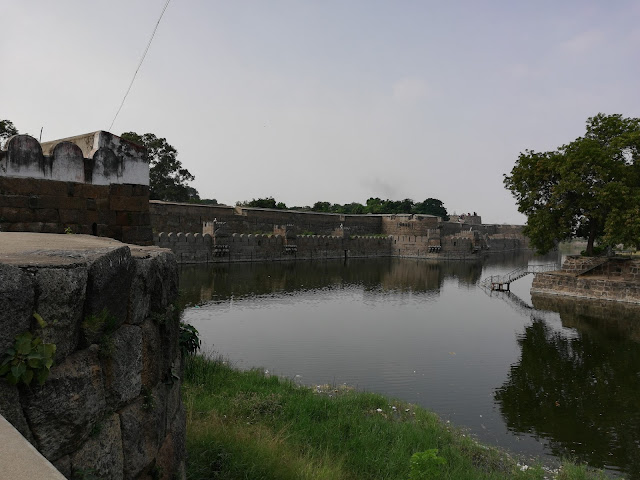
Overview: After our visit to the Armamalai Caves, we decided to wrap up our day with a visit to the Vellore Fort and the Tomb of the last ruler from Kandy, Ceylon (Sri Lanka). The fort is surrounded by water from all sides, built in such a way to prevent the intruders from entering the area. The fort dates back to the 16th century, probably used by several dynasties including the Vijayanagara, Tipu Sultan and the British. The fort occupies a huge area of around 130 acres and houses a mosque, the St John's church and Jalakantheshwara temple. The mosque dates to the Nawabs of Arcot, the church was built by Robert Clive built in the 1800s. The Jalakantheshwara temple is a massive structure, typical architecture of the Vijayanagara kings. The temple was closed by the time we reached the place so unfortunately we missed the interior architecture of the temple. The fort also has 2 museums, which has artifacts from the entire district. Also within the fort is the Hyder Mahal and Tipu ...

Ashokan Edicts and Pillar inscriptions in Delhi

Image
Overview: In my recent trip to Delhi, I decided to take a very non-touristy trail. I had heard about the remains of Ashoka's edicts and pillar inscriptions within the city of Delhi. After the Kalinga war, Emperor Ashoka traveled across the country to spread his message of Buddhism. This is a minor edict in Greater Kailash area of South Delhi, and is protected inside a concrete cage. The writings are barely visible through the bars, and the approach to this hill is through a well laid path. One of the theories suggests that this site was a part of the ancient trade route linking the Gangetic plains to the north western part of India. Such major and minor rock edicts can be seen all across India, from Delhi to Madhya Pradesh to Chattisgarh to Karnataka. Path way to Ashokan Edict in Delhi Ashokan Edict in Delhi Pillar Inscriptions in Delhi: A couple of pillar inscriptions can be seen in Delhi today. These pillars were quarried and polished at Chunar, near Varanasi. The re...

Stepwells of Delhi NCR

Image
Overview: All know that the Delhi NCR is a treasure trove for history lovers and my visit was filled with interesting findings. I had heard about several Baolis, or Stepped wells as they are called, built in a very artistic way, and built by the Chauhans, the Lodhis, the Tughlaqs and later learnt by the Mughals too. We explored Agrasen ki Baoli, right in the middle of the city, close to Jantar Mantar. This Baoli is a three level stepwell, built initially in the 10th century by king Agrasen, later renovated by other kings. The next Baoli we visited was within the Purana Quila, which is a narrow stepwell, dates back to the 15th century, during the time of Shershah Suri. Rajon ki Baoli: A very royal Baoli lies inside the Mehrauli Archaeological Park built in the 15th century during the rule of Sikandar Lodhi. Its a pretty stepwell, with a wide walkway surrounding the well, and decorated by beautiful stonework on the windows. Gandhak ki Baoli: Adjacent to Mehrauli Archaeological Park ...